Risk Management in Financial Planning: The 6 Risks That Can Wreck Your Plan
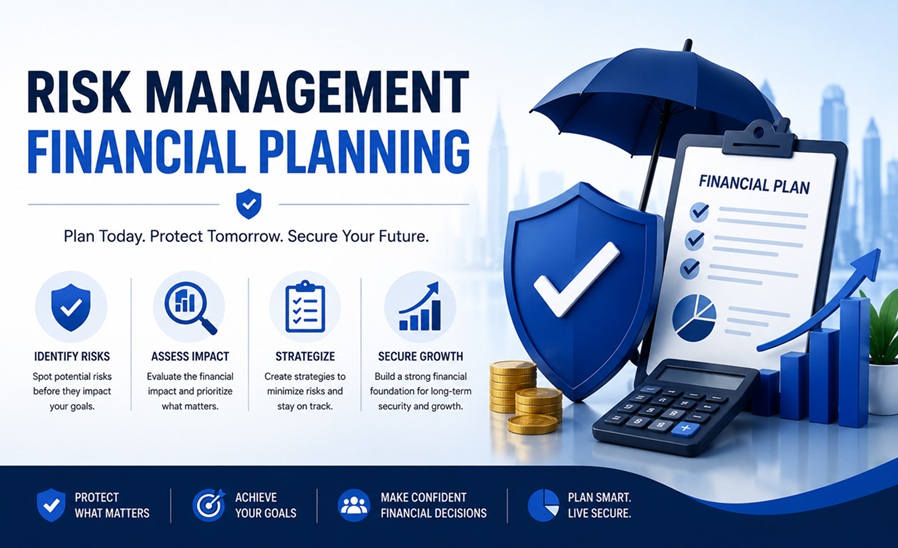

Risk management in financial planning means identifying the events that could derail your plan and putting protections in place before they happen. Most plans focus too much on investment risk and not enough on the bigger threats: disability, premature death, longevity, liability, inflation, and concentration. The math is almost always the opposite of the emotion — people insure against what scares them, not what would actually wreck them.
The framework that works is simple: insure the catastrophic, self-insure the small stuff. A broken phone is annoying; a permanent disability that ends your career is plan-ending. Yet most people have phone insurance and no disability coverage.
The 6 Main Financial Risks
| Risk Type | Who’s Exposed | Primary Defense |
|---|---|---|
| Premature death | Anyone with dependents or shared debt | Term life insurance |
| Disability | Anyone with earned income | Long-term disability insurance |
| Longevity (outliving money) | Retirees, especially women | Annuities, conservative withdrawal rates |
| Liability | Anyone with assets or income | Umbrella insurance, asset protection |
| Inflation | Anyone with long horizons | Equity exposure, TIPS, real assets |
| Concentration | Owners, employees with stock comp | Diversification, hedging strategies |
Why Disability Insurance Is the Most-Skipped, Most-Important Policy
Your earning power is your single biggest financial asset. A 35-year-old earning $80,000 a year has roughly $2.4 million in lifetime earnings ahead of them. Disability is statistically more likely than premature death during working years — yet term life insurance is purchased far more often than long-term disability coverage.
If your employer offers group disability, check the details: most group policies cover 60% of base salary (not bonus), cap monthly benefits, and have taxable benefits when the employer pays the premium. An individual policy can supplement this and lock in coverage that follows you between jobs.
The Risk Pyramid Framework
| Probability | Severity | What to Do |
|---|---|---|
| Low probability, high severity | Catastrophic and rare | Insure aggressively |
| High probability, low severity | Common, annoying | Self-insure or budget for |
| Low probability, low severity | Unlikely and minor | Ignore |
| High probability, high severity | Avoid the activity if possible | Insure and reduce exposure |
The catastrophic-and-rare category — premature death, permanent disability, lawsuit, major medical event — is what insurance was designed for. Routine costs like minor car repairs or phone replacement aren’t insurable risks; they’re budget items.
Diversification as Risk Management (Not Just Investing)
Diversification isn’t only an investment principle — it’s a risk-management principle that applies across the whole plan:
- Income sources — single-income households are more exposed than dual-income
- Account types — pre-tax + Roth + taxable gives flexibility in retirement
- Geography — for property and investments
- Skills — career diversification reduces obsolescence risk
A concentrated portfolio is one form of risk. A concentrated career, in a single company or industry, is another.
Estate Planning as Risk Management
What happens if you’re incapacitated — not just if you die — is often the bigger immediate risk. Documents to have in place:
- Will — what happens to your assets when you die
- Revocable trust (when appropriate) — avoids probate, handles incapacity
- Power of attorney — financial decisions if you can’t make them
- Healthcare directive — medical decisions if you can’t make them
- HIPAA authorization — who can access your medical info
Without these, families often spend months in court establishing guardianship — at the worst possible emotional moment.
Common Risk-Management Gaps
- No umbrella policy at $500K+ net worth. $1M of coverage typically costs $200–$400 a year. Skipping it on a meaningful net worth is one of the cheapest mistakes to fix.
- No disability insurance. See above.
- Wrong beneficiaries — ex-spouses still listed, kids not updated, no contingent beneficiary at all.
- Over-insurance on cars and phones, under-insurance on life and disability.
- No emergency fund — leaves you forced to liquidate retirement assets during any setback.
Bottom Line
People insure against the risks that scare them — fender benders, broken phones — while ignoring the ones that would actually wreck them. The math says the opposite: insure the catastrophic, accept the routine. Build the risk-management layer of your plan before optimizing the growth side, because no return matters if a single uninsured event takes it all back.